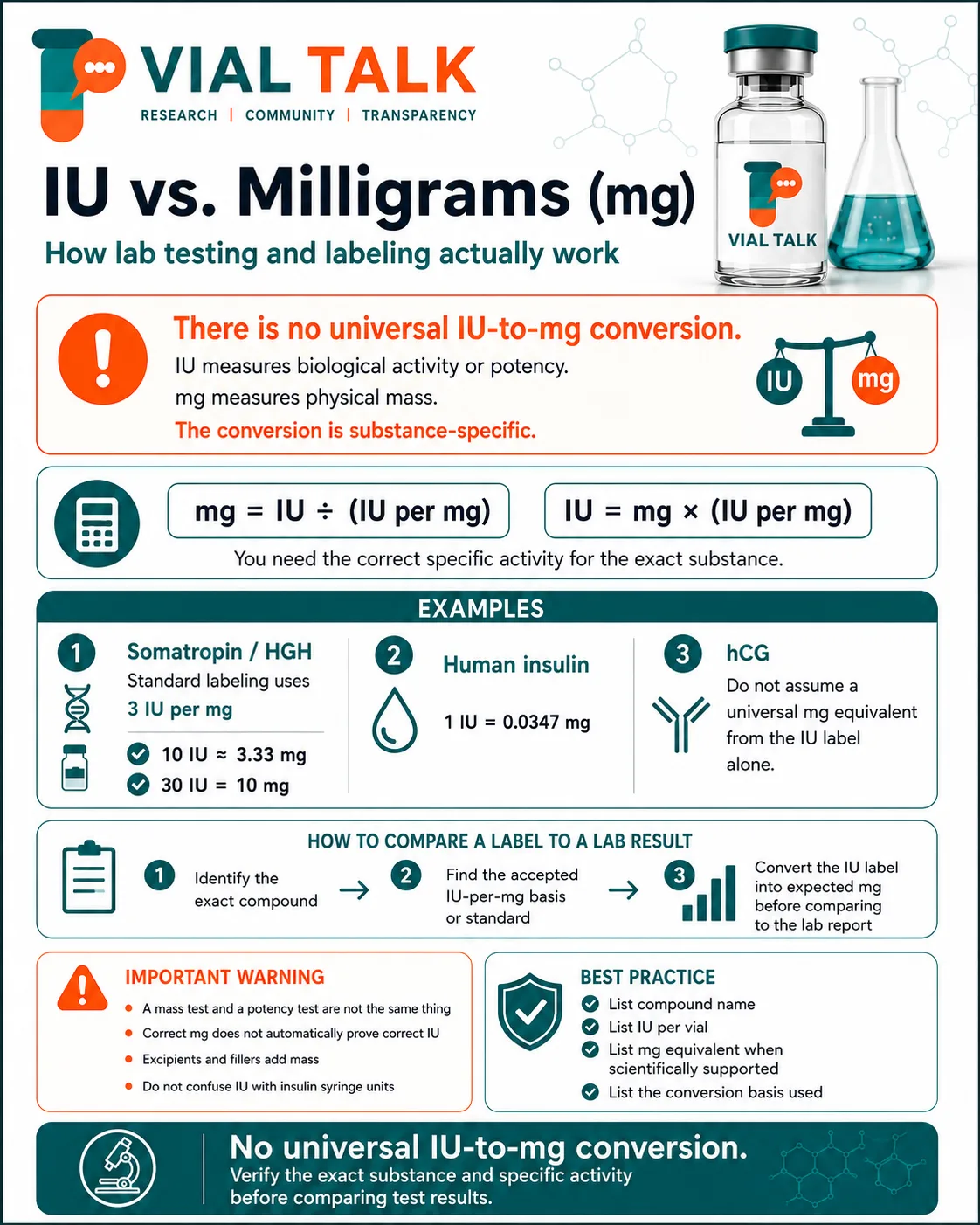
One of the most common points of confusion with HGH testing is the difference between International Units (IU) and milligrams (mg).
A website may list a vial as:
10 IU HGH
3.33 mg somatropin
10 IU / 3.33 mg
For standard 191-amino-acid somatropin, those labels can describe approximately the same amount.
The commonly used conversion is:
3 IU of somatropin = approximately 1 mg
That means:
10 IU = approximately 3.33 mg
12 IU = approximately 4 mg
15 IU = approximately 5 mg
24 IU = approximately 8 mg
30 IU = approximately 10 mg
36 IU = approximately 12 mg
100 IU = approximately 33.33 mg
This conversion applies specifically to standard somatropin. It should not automatically be used for hCG, insulin, EPO, or other compounds.
An IU measures biological activity or potency.
A milligram measures physical mass.
People commonly talk about HGH in IU, but laboratories often report the amount of somatropin found in a vial as mg per vial.
That is why one vendor may advertise a vial as 30 IU, while another may advertise what appears to be the same strength as 10 mg.
For standard somatropin:
30 IU and 10 mg represent approximately the same label claim.
The clearest and most transparent product listing would show both:
30 IU somatropin — approximately 10 mg per vial
This allows customers and researchers to compare the website listing directly with the laboratory result.
For standard somatropin using the 3 IU-per-mg conversion:
Milligrams = IU divided by 3
Examples:
10 IU divided by 3 = approximately 3.33 mg
30 IU divided by 3 = 10 mg
100 IU divided by 3 = approximately 33.33 mg
For standard somatropin:
IU = milligrams multiplied by 3
Examples:
3.33 mg multiplied by 3 = approximately 10 IU
5 mg multiplied by 3 = 15 IU
10 mg multiplied by 3 = 30 IU
What happens when HGH is sent to a laboratory?
The exact testing process depends on the laboratory and which testing package is ordered.
A laboratory may examine several different things.
This answers:
Is the material actually somatropin?
Identity testing helps determine whether the compound matches the expected substance.
This answers:
What percentage of the detected material appears to be the intended compound?
Purity testing may also identify related substances, degradation products, or other impurities detected by the method.
This answers:
How many milligrams of somatropin are present in the vial?
This is the part of the report that can normally be compared with the expected mg equivalent of the IU label.
This answers:
Does the material produce the expected biological activity?
A biological potency test is different from a basic mass or quantity test. A vial may contain the expected number of milligrams without necessarily proving that every milligram retains the expected biological activity.
Example: Comparing a 30 IU vial with a lab result
Imagine a vial is labeled:
30 IU somatropin
Using the standard conversion:
30 IU divided by 3 IU per mg = 10 mg
The expected quantitative laboratory result would therefore be approximately:
10 mg of somatropin per vial
If the laboratory reports approximately 10 mg, the measured mass is consistent with the 30 IU label claim.
However, this does not automatically prove that the vial has exactly 30 IU of biological potency.
A mass test and a potency test are not the same thing.
Why a correct milligram result does not prove everything
A sample could theoretically contain the expected mass while some of the material is:
Degraded
Oxidized
Aggregated
Chemically modified
Improperly folded
Damaged by heat or storage conditions
Less biologically active than expected
This is why it is important to read exactly what the laboratory report says.
These statements do not all mean the same thing:
10 mg detected
99% purity
Identity confirmed
30 IU biological potency confirmed
Each statement describes a different part of the testing process.
The visible powder does not tell you the HGH amount
The lyophilized puck inside a vial may contain more than the active somatropin.
The dried material may also contain:
Buffers
Salts
Stabilizers
Bulking agents
Fillers
Residual moisture
Other excipients
Because of this, a larger puck does not automatically mean more HGH.
A smaller puck does not automatically mean less HGH.
The active somatropin must be specifically identified and quantified by the laboratory.
Simply weighing the entire puck would include the active ingredient, excipients, and residual moisture together.
Do not confuse IU with insulin-syringe units
This is another common misunderstanding.
IU on an HGH label describes biological activity.
The numbered units on a U-100 insulin syringe describe liquid volume.
For a U-100 syringe:
100 syringe units = 1 mL
50 syringe units = 0.5 mL
10 syringe units = 0.1 mL
The syringe markings do not automatically tell you how many IU or milligrams are present.
That depends on:
The amount of somatropin in the vial
The volume used to reconstitute it
The final concentration of the solution
Syringe units, HGH IU, and milligrams are three different measurements.
What vendors should show on their websites
For maximum transparency, a somatropin product page should ideally include:
Compound: Somatropin, 191 amino acids
Label claim: 30 IU per vial
Mass equivalent: Approximately 10 mg per vial
Conversion basis: 3 IU per mg
Testing performed: Identity, purity, and quantitative assay
Potency status: Clearly state whether biological potency was separately tested
Showing both IU and mg makes it much easier to compare the product listing with the laboratory report.
Questions to ask when reviewing an HGH COA
Before comparing a COA with a product label, ask:
Does the report confirm the identity as somatropin?
Does it report purity?
Does it report the quantity in mg per vial?
Was the full vial tested?
Were excipients excluded from the active-content result?
Does the report measure mass, biological potency, or both?
Is the result corrected for water content or moisture?
What reference standard was used?
Does the report include aggregates or degradation products?
A report that only says “10 mg” may not tell the entire story unless it clearly explains what was measured.
The biggest takeaway
For standard somatropin:
3 IU is approximately equal to 1 mg
Therefore:
10 IU is approximately 3.33 mg
30 IU is approximately 10 mg
But there is no universal IU-to-mg conversion for every compound.
The proper process is:
Identify the exact compound.
Confirm the accepted IU-per-mg relationship.
Convert the label claim into the expected milligram amount.
Compare it with what the laboratory actually measured.
Check whether the report measured mass, purity, identity, biological potency, or a combination of these.
The more clearly vendors display both IU and mg, and the more clearly laboratories describe their testing methods, the easier it becomes for the community to make accurate comparisons.
This post is for research-testing, labeling, and educational discussion only. It is not medical advice, dosing guidance, or a recommendation for human use.